Friday, March 30, 2018


Watchingwell   


             Curated classic films


IN CHARGE


      Some notice has been taken of the admirable work in recent films of women directors – Ava DuVernay for A Wrinkle in Time, and Selma, Kathryn Bigelow for Hurt Locker and Detroit, and Patty Jenkins for Wonder Woman, for examples, and it’s high time. The recent nomination at the 2018 Academy Awards of Agnes Varda, a trailblazer director from Belgium and the recognition of her body of work in less enlightened times also points to the rarity of women in the position of ‘auteur’ in film.


     This is, as I have said, as it should be, but I would like to remind everyone of two women who worked regularly as directors in the less enlightened times.  The first, and probably, most difficult to explain, is the career with the largest body of work of a woman director, occurring during Hollywood’s so-called Golden Age, Dorothy Arzner.  For some reason that no one seems to explain convincingly, Arzner was
given regular work as a director in the studio system. Born in San Francisco in 1897 and raised in Los Angeles, she was introduced to William DeMille (brother of Cecil B.) and hired as a stenographer for what eventually became Paramount Pictures.  Her first assignment was to type up scripts.  She worked her way up from there to writer, script girl, editor (she was the first Hollywood editor to be credited on-screen).  In 1927, she was given a chance to direct a silent film, which was so successful that she was given another film to direct, Paramount’s first talkie in 1928, the first woman to direct a sound picture.  Strangely, women directors were not that uncommon in silent films, but Arzner seems to be the only one to have transitioned to the sound era.


     After making Merrily We Go to Hell from pre-code
1932, the story of a man who marries and drags his new wife down the destructive path of alcoholism, with fine performances from Fredric March and Sylvia Sidney, Arzner left Paramount to freelance.  She was hired by RKO to direct Katherine Hepburn in her second role as an aviatrix having an affair with a married man, in Christopher Strong (1933), a film
which stands out in my memory as the one with Hepburn in a moth costume. It is not clear in my mind whether she wears this to a costume party or just had strange ideas about party clothes.  Colin Clive, her co-star, does not strike one as someone that would inspire a brave aviatrix to engage in illicit love, particularly with the husband and father of friends, but it was a fun picture, if just for the costumes.


     Although Arzner is reputed to have had a difficult relationship with Hepburn, she formed a long friendship with Joan Crawford, during the filming of two pictures from 1937, which extended to the commercials she directed for Pepsi Cola while Crawford was married to the boss and after Arzner had left film directing. 
The Last of Mrs. Cheney, also starring Robert Montgomery and William Powell is a rare comedy for Crawford who plays a rich, American widow – or is she?  The other film from 1937 is The Bride Wore Red, co-starring Franchot Tone and Robert Young. In this story, Crawford is a poor girl who has two weeks to find a rich husband at a resort, although she is in love with a poor postman.


“What’s it for?” Judy demands. “So you can go home when the show’s over, strut before your wives and sweethearts and play at being the stronger sex for a minute? I’m sure they see through you. I’m sure they see through you just like we do!” 
     With these lines, Arzner’s 1940 semi-comedy, Dance Girl Dance, became forever celebrated as a feminist commentary as well as a veiled critique of Hollywood’s male hierarchy.  Spoken before a burlesque audience that had booed her ballet dance  while gearing up for the real attraction, Bubbles, played by Lucille Ball, Maureen O’Hara changes from the mere warm-up act for her successful friend to the strong woman who finally sees things as they really are.
It is assumed by some that this perception was possible because of the combination of the Vicki Baum story, the screenplay by the married team of Tess Slesinger and Frank Davis, and the  woman director, and that this angle would not have been as strong if the creative team had been comprised of all men. 


     In 1943, Arzner joined the war effort by making training films for the WACs.  After the war, health problems prevented her from returning to directing feature films, although she did direct documentaries and commercials for television.  During the 60s and 70s, she taught filmmaking at UCLA. Dorothy Arzner died in 1979 at the age of 82.
uuuuu


      The English actress, Ida Lupino, having co-written the script of the 1949, Not Wanted, was given her first directing job when the director, Elmer Clifton, fell ill during the filming. The results were successful enough that Lupino was able to secure more work as a director, and, although these were generally considered ‘B‘ pictures,  she quickly showed a distinct point-of-view, creating well-regarded work in stylish, black and white noir-y pictures. 

     In the 1950 film, Outrage, the script, which
Lupino co-wrote, focuses on a rape, which had to be called “criminal assault” in 1950, which suggests how rare it was for Hollywood to deal with the subject, and its aftermath, with very little held back, emotionally.  It portrays the terror of the act and the distress that follows for the main character, played by Mala Powers, in a manner that would have seemed uncompromising at the time, and undoubtedly a manner resulting from a very personal female vantage point of the writer/director.
     In 1951, Lupino directed Claire Trevor and Sally Forrest in the unfortunately-titled, Hard, Fast, and Beautiful, the story of a talented tennis protégée, Forrest, whose mother, Trevor, sees a big future for them both and keeps a tight rein on her daughter’s life to protect that dream.  Naturally, romance rears its ugly head and Forrest realizes she has a conflict.
     Two of Lupino’s films were released in 1953, one of which, The Hitch-Hiker, starring Edmond O’Brien
and Frank Lovejoy as two men on a fishing trip who pick up psychotic, William Talman (Hamilton Burger on Perry Mason) on the road, is a real thriller and a genuine film noir, the only one directed by a  woman.
.       Lupino also co-wrote this with her writing partner, Collier Young, with whom she wrote the other film of 1953 that she directed, The Bigamist. Again starring Edmond O’Brien as the title character and co-starring Joan Fontaine and Ida, who was still acting, as the two women who are each unaware of the other.


     By 1956, she turned to television where she directed episodes in many popular shows such as The Untouchables, Thriller, and The Fugitive. Through the seventies, Lupino continued to act, in guest appearances on television and small parts in a few movies. During this period, she did direct one particular feature film that is one of my inexplicably, personal favorites, The Trouble With Angels (1966), starring Hayley Mills and Rosalind Russell.  When I first saw this, I laughed till I cried in the cigar scene, but not in subsequent viewings.     
It is a heartwarming film, I suppose, and Hayley Mills was great at pulling off the right tone for zany, comedy scenes (I still use the term, “scathingly brilliant idea”, which she did frequently in the film.).  But, if you ever saw Ida Lupino and her then-husband, Howard Duff, when they guest-starred on The Lucy-Desi Comedy Hour in 1959, or the couple’s short-lived sit-com, Mr. Adams and Eve, you will remember what a hoot Ida Lupino was as a comedienne and wish she had been given the chance to try her hand at directing comedies.

     The second woman to be admitted into the Director’s Guild, after Dorothy Arzner, Ida Lupino died in Los Angles in 1995 at the age of 77.


uuuuu


Wednesday, February 14, 2018


Watchingwell   


             Curated classic films


Speaking of… Love

     My nomination for the best love story of the classic film era is an adaption of a great novel so it has a head start.  But as we know, Hollywood doesn’t have an unblemished track record in this area, so it could also be a handicap.  Anyway, my choice is Wuthering Heights from 1939.  It fulfills my requirements, totally arbitrary, of what does and does not constitute a great love story.  It is not about a love that is made poignant by suffering and separation due to contrived accidents of Fate, or the blindness of one of the individuals that is only lifted at the last moment of the film.  This lets out Random Harvest, Gone with the Wind, Romeo and Juliet (in all its forms), The Shop Around the Corner, and the one that YOU are thinking about.


     Yes, WH has suffering and separation, but the love story is not defined by this – it actually serves to underline the resilience of the bond between Cathy and Heathcliff. The pair are never out of love, even when absent from each other, even when married to others, while, at the same time they seem to accept that they cannot be together.  All right, it is a fine line I draw, but it’s my party.  The fact is that the inescapable-love-as-obsession story by Emily Bronte was pretty well realized by the screenplay by Ben Hecht and the direction of William Wyler.  But a large part of the credit must go to Laurence Olivier who really ‘got’ Heathcliff, and sold us the tortured soul who was incapable of separating from Cathy’s even when realizing the shallow character of hers.  It took me years to look at Merle Oberon’s performance objectively, after my aunt had poisoned my child’s mind with her criticism of her “cat-like” looks and bad acting. Actually, she does a credible job with a difficult role.  My aunt, whose opinion of Oberon did not prevent her from loving the film, thought Vivien Leigh would have been better in the part.  So, reportedly, did Olivier. But I disagree.  I think I even disagreed when I was a child.  Leigh was too delicate.  Cathy needed to be robust, a child of the moors, a tomboy, who rode horses and scrambled up the rocky outgrowths of Penistone Crag. So, Oberon did OK, except for a little too much emoting in the moments before she dies.  Oh – spoiler alert, I guess.  And, in her most important scene, IMO, in the kitchen with her maid/confidante, when she admits how she is hopelessly bonded to Heathcliff, and suddenly, framed by lightning, declares, “Ellen, sometimes I think I am Heathcliff”, she understands this revelation has to balance all the behavior that otherwise would make her unlikable.  And, although the words are Emily Bronte’s, they are probably the most eloquent expression of love you see on American film before the modern era.  Second to this would be the speech Heathcliff pronounces over the newly-dead Cathy begging her to  haunt him, “only never leave me alone in this abyss”. 


     Speaking of Laurence Olivier, and women novelists who were adapted into decent movies, I must give a nod to the 1940 version of Pride and Prejudice, directed by  
Robert Z. Leonard, with Greer Garson as Elizabeth Bennet and Olivier as Mr. Darcy.  I have never seen a bad film of P&P, come to think of it, and although Garson seems a little more mature than some of the other Elizabeths, it works in a different kind of way, because no matter who pronounces the words, they are good words. This is a satisfying romance where the audience knows before the two protagonists that they will end up together, and it is sooo lovely to hear Olivier and Garson speak English.


     Speaking of director, William Wyler, you’ve got to give him credit for recognizing the screen magic that Audrey Hepburn would produce in her first starring role as the errant princess in the 1953 film, Roman Holiday, written by Ian MacLellan Hunter, fronting for the blacklisted, Dalton Trumbo. With Gregory Peck who plays the reporter who tries to capitalize on his luck in finding her and ends up falling in love, as audiences did.  And she falls for him as they spend one glorious day and night in Rome before she tears herself away from him and returns to her important princess duties.  Who doesn’t cry at that ending?


     Breaking away from women novelists, but back to Ben Hecht, who, let’s face it, was a great and prolific American writer, we turn to one of my faves of all categories, Notorious, from 1946, directed by Alfred Hitchcock. Starring Ingrid Bergman as a woman who is recruited by the American government to spy on Nazis in South America and Cary Grant as her ‘handler’ who gets emotionally involved and then feels guilty, so he feigns detachment and then feels guilty for that.  Cary Grant plays a more stoical version of his usual self, made even more so by the naturalistic Bergman.  There is great chemistry between them and tension, as only Hitchcock knows how to provide.  The ending, with its revolving shot of their whispered embrace is made more explicit by the touch of realism that Bergman brought to every role.


     Speaking of William Wyler again, a powerful love story is enclosed in the multi-layered The Best Years of Our Lives (1946) between Dana Andrews and Teresa Wright.  The screen play by Robert E. Sherwood from the novel by MacKinlay Kantor is about America’s post-war adjustment, but it is contained in several story lines. The love story of Frederic March and Myrna Loy is poignantly expressed to their daughter, Wright, as they oppose her  relationship with Andrews who is married, unhappily, to Virginia Mayo.  But by the touching wedding ceremony they all attend at the end, we know that true love has won out. Tears are required here also.

    Speaking of Dana Andrews, he becomes obsessively in love with a murder victim in Laura, the 1944 film noir directed by Otto Preminger.  Based on the novel by Vera Caspary, the screen play by Jay Dratler, Samuel Hoffenstein, and Betty Reinhardt  (with an uncredited Ring Lardner, Jr). displays just the right tone of cynical and witty dialogue. Of course, Laura Hunt, played by Gene Tierney isn’t really dead.  But by the time she shows up in the film, Andrews is already on the verge of losing his professional judgment.  This tension is balanced by Tierney’s calm influence, which, in the end, is no match for obsession.  She falls under his spell. Yes, it is a murder mystery.   But it is a love story, too.


     I have posted a clip and written before about the 1943 film The More the Merrier, directed by George Stevens so I need to remind everyone again what a good love story Joel McCrea and Jean Arthur make of this comedy.  In this case, the comedy takes the edge off the emotional content, so it can’t be a great love story.(My rules.)  But a comedy is useful to take the edge off the shocking (for 1943) theme of an unmarried couple forced to cohabitate by unusual circumstances and fall in love as a result.  A similar (and also shocking for 1934) route to love was taken
by Clark Gable and Claudette Colbert in another successful comedy/ romance, It Happened One Night, directed by Frank Capra. This theme is a handy way to speed along the slow process of really getting to know someone, especially someone who initially doesn’t interest you.


     Speaking of which, this is precisely what happens in the 1945 film, Without Love, directed by Harold S. Bucquet and starring Katherine Hepburn and Spencer Tracy in one of their less-famous vehicles. Written by Donald Ogden Stewart and based on the play by Philip Barry (Philadelphia Story, Holiday), the ‘marriage of convenience’ between the two stars is a tender story of how fragile people who want to be emotionally safe are enticed into trying again.  There is a great supporting performance by Lucille Ball that livens up the drama.

     Speaking of a marriage of convenience, this is the plot device in a charming romance from 1944, Come Live with
Me, starring James Stewart and Hedy Lamarr and directed by Clarence Brown. In a seemingly timeless theme, Hedy is an immigrant facing deportation, but in those days, you could stay if you were married to a citizen for love and not for avoiding deportation.  So, when Hedy meets struggling writer, James Stewart, she proposes a strictly business arrangement, offering to help him financially, which she can do with the help of her wealthy, but married boyfriend.  However, the lovely Lamarr gives a convincing performance of a sophisticated woman who comes to appreciate the honest relationship with Stewart more than she had anticipated.


Love and chocolate to you.


Tuesday, January 30, 2018

Watchingwell   


             Curated classic films


Guilty Pleasures
Movies that are so bad, they’re good

     A few days ago, I was intrigued by a cheesy film title that was appearing on TV that night.  I watched and laughed, imagining what they would be saying on Mystery Science Theater 3000, the cult program where the characters hilariously commented on really bad movies, at the various points of a sad script and careless inconsistencies. This led me to think about other films that I have never before admitted to watching that perhaps other people have viewed in secret. Maybe you’ve never watched them because they sound terrible. Don’t be ashamed!  Nothing makes you aware of the components of professional filmmaking like watching one that seems to lack them.  And sometimes watching a laughably bad film is a fun social activity.  In this season of nominations, these are my selections for the non-excellence awards, but  good for a  laugh and a sense of wonder about how they got produced and released in the first place.  But, hey, the fifties were kind of nutty.


Attack of the 50 Foot Woman (1958)  Directed by Nathan Juran

We don't know exactly what, but something happens to the unhappy woman when she encounters an alien in the desert and is carried away by same, that made her grow and grow and take revenge on her cheat of a husband.


Attack of the Crab Monsters (1957)
Directed by Roger Corman.

You guessed it – radiation is to blame for creating gigantic, murderous crabs who want to eat the scientists on the island for their knowledge.


Attack of the Giant Leeches (1959) Directed by Bernard L. Kowalski

Another “Attack of…”  Well, they don’t attack unless you are foolish enough to go down to the swamp after several people have disappeared when they went down there.  Not the worst of the bunch, actually, or have I had my standards lowered?


Amazing Colossal Man (1957) Directed by Bert I. Gordon


 This is the man-exposed–to-plutonium-bomb-blast plot, where he grows too fast for his blood supply to his brain and becomes insane and attacks Las Vegas. Is there a message here?


The Wasp Woman (1959) Directed by Roger Corman


Where a cosmetics executive experiments with herself with wasp juice to remain eternally youthful. I know, foolish, right?  Hmm, I wonder if anything came of that. 


Bride of the Monster (1955) Directed by Edward D. Wood, Jr.


If you don’t know Ed Wood, this is his best.  A mad scientist attempts to create a super being with atomic radiation.  The best thing about this is Bela Lugosi, who, while old, is still able to infuse some authenticity to the dialogue.


Plan 9 From Outer Space (1959) Directed by Edward D. Wood, Jr.
Ed Wood’s second best/worst.  Aliens try to stop humans from developing a ‘sun bomb’ by turning dead people into zombies and vampires. Some would argue that it’s not the worst film ever made because although inept on every level, it is strangely entertaining.


Robot Monster (1953) Directed by Phil Tucker.

Picture that's worth a thousand words. Not really my idea of what a robot monster would look like, unless it was all I could find for my backyard production -- when I was seven. Title monster wipes out all but eight of the Earth’s population in a cheapie production that makes Ed Wood look like a genius. That alone makes it worth viewing.


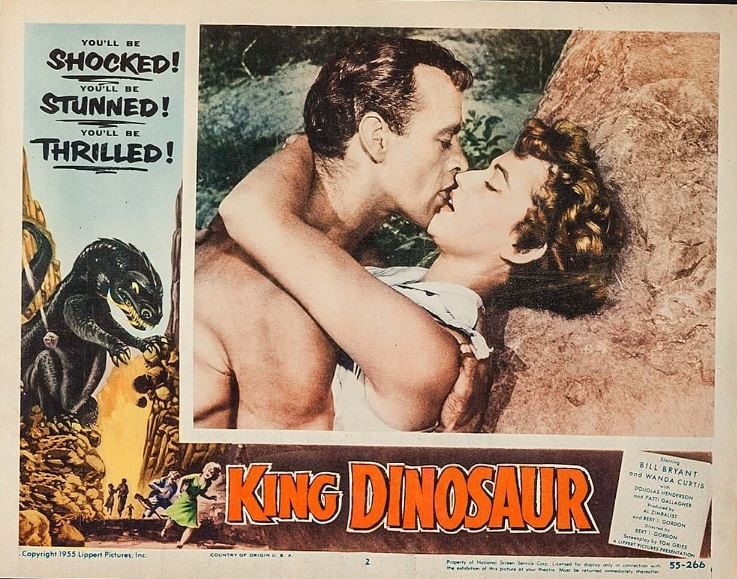
King Dinosaur (1955) Directed by Bert I. Gordon.

Two astronaut couples (cute concept!) are sent to a newly discovered planet that looks a lot like Earth with the same animals and a low budget dinosaur (lizard). When the mean dinosaur threatens them, they obliterate the planet with an atomic bomb. We don’t come in peace.


The Giant Claw (1957) Directed by Fred F. Sears


     Astonishingly ridiculous-looking, alien, big bird attacks Earth while trying to lay eggs.  A script this bad doesn't get created without determined concentration. B-picture actor Jeff Morrow actually worked again after this embarrassment.

Have I missed anyone's best/worst favorite?


I love this still photo from It Conquered the World (1956)  another great one directed by Roger Corman. Yes, and Beverly Garland also worked again after this.


Monday, December 18, 2017

Watchingwell   


             Curated classic films


Dear Readers,

      In the spirit of the season, instead of suggestions about classic holiday films, which you can still read if you scroll back in time, I offer presents for your viewing enjoyment.


Happy Holidays!