Watchingwell

Curated classic films
The 1940s
The Comedies
The Comedies
Back to the film literacy department, here is my list of iconic comedies of the 1940s. A slight change of format here -- instead of the usual list of the most important 20, I am taking the liberty of selecting my favorite five of the list to discuss in more detail. Again, I remind you that these 20, including my favorite five, are not necessarily the funniest, but rather, the ones you should know about if you want to know Hollywood comedy in the 40s.
If I had to choose one film, to take to the desert island (thank goodness, I don't), maybe I would choose His Girl Friday, a film from 1940 directed by Howard Hawks. An earlier version of the Charles MacArthur-Ben Hecht 1928 play was made into a film in 1931 with Adolph Menjou and Pat O'Brien. (There were later film versions made as well, but this one from 1940 is the best.) Howard Hawks changed the Pat O'Brien role of Hildy Johnson into a woman, played by Rosalind Russell, adding a new dimension to the plot. Cary Grant plays Walter Burns, the newspaper editor who would go to any length to beat the competition to a story.
The dialogue is fast and overlapping, a specialty of Hawks direction. In one scene that illustrates this and one that you'd have to see more than once to notice all the nuances of the performances, Rosalind Russell is typing the breaking story, while Walter (Cary Grant) is helping her with background and at the same time, speaking on the phone with his editor. Ralph Bellamy as Bruce, who is engaged to Hildy, is hovering over her trying to get her away and on the train to Albany. So we have Bruce talking to Hildy, Hildy answering him and asking Walter questions and typing while reading out loud what she is typing. Walter is talking to Hildy, to his editor on the phone and also to Bruce, accusing him of distracting Hildy, and Bruce is also answering him. While all this is going on, someone mentions Bruce's money that Hildy was holding for him which Walter knows has been exchanged for counterfeit, and he inspects the money to check whether it is real or not. The scene runs seamlessly and is a master class in filmmaking.
The dialogue is fast and overlapping, a specialty of Hawks direction. In one scene that illustrates this and one that you'd have to see more than once to notice all the nuances of the performances, Rosalind Russell is typing the breaking story, while Walter (Cary Grant) is helping her with background and at the same time, speaking on the phone with his editor. Ralph Bellamy as Bruce, who is engaged to Hildy, is hovering over her trying to get her away and on the train to Albany. So we have Bruce talking to Hildy, Hildy answering him and asking Walter questions and typing while reading out loud what she is typing. Walter is talking to Hildy, to his editor on the phone and also to Bruce, accusing him of distracting Hildy, and Bruce is also answering him. While all this is going on, someone mentions Bruce's money that Hildy was holding for him which Walter knows has been exchanged for counterfeit, and he inspects the money to check whether it is real or not. The scene runs seamlessly and is a master class in filmmaking.
There is another scene where Abner Biberman, who plays Walter's devoted and slightly crooked fixer, has returned to the courthouse to report that his car was in a crash with a police car and implies that Hildy's future mother-in-law might have been killed. While he is recounting the events to Walter, Hildy is on the phone to the hospitals, asking if an old woman has been brought in. I have seen this film a dozen times and this scene never fails to make me laugh.
Cary Grant does not always play himself, as some may think. His Walter Burns is a newspaper man and con artist, a businessman who knows what sells, with very little in the way of scruples. His speech patterns reflect that -- hard edged, slightly insincere, and so do his clothes, well-dressed but a little flashy, with a flower in his lapel. Rosalind Russell is an able match as Hildy, the ultimate career woman, an attractive woman, yet clearly respected and admired by the newspapermen on the beat. You don't find too many career woman stories from those days that didn't end with a subtle message to girls that a professional life was not for them. This one was unique because since Hildy was originally written as a man, the role still required that she was a great reporter in order for the plot to work. In the end, when she goes off with Walter, resigned to his faults as a partner, it is obvious she is not leaving her career. They go off together to cover a strike in Albany, with Hildy carrying her own suitcases and Walter musing aloud that perhaps Bruce, the jilted fiance, will put them up.
As I have previously written, I have watched old films since childhood, so it was with pleasant surprise that I found this film for the first time not so many years ago. The plot is ridiculous -- I mean, really ridiculous. Claudette Colbert is in love with her husband, Joel McCrea, but since they are without enough capital to bankroll his canopy airport idea, she decides to divorce him so he can work without worrying about her, and she can find some man to supply the cash in return for her favors. Did you notice three or four ridiculous items here? Wait, there's more.
There is a rich businessman from the Midwest who gives her enough to pay the unpaid bills, a hunting club who buys her a ticket on the train car they have booked for their trip to Florida, and a Rockefeller-type, played by Rudy Vallee, who takes her the rest of the way on his yacht after the hunters' car is uncoupled from the train, but not before he buys her a complete designer wardrobe, with jewels.
When they get to Florida, they are met by Vallee's sister, played by Mary Astor, and also, Joel McCrea, who has followed his wife to Palm Beach, but whom she introduces as her brother. But as we are refusing to suspend our disbelief with this insanity, we are also laughing at the script anyway, and this is the essence of Preston Sturges comedy -- a ridiculous premise that plays out with such convincing wit that we accept the ridiculous as normal. My favorite line comes when Vallee shows his sister a Hope-diamond-size ring he has bought for Colbert. He asks her what she thinks and Astor replies, "I think she'll know what you mean."
*****
Preston Sturges has the deserved reputation for original, sophisticated comedy writing and direction. Of the three Sturges films included in my top 20, The Palm Beach Story from 1942 is my favorite.As I have previously written, I have watched old films since childhood, so it was with pleasant surprise that I found this film for the first time not so many years ago. The plot is ridiculous -- I mean, really ridiculous. Claudette Colbert is in love with her husband, Joel McCrea, but since they are without enough capital to bankroll his canopy airport idea, she decides to divorce him so he can work without worrying about her, and she can find some man to supply the cash in return for her favors. Did you notice three or four ridiculous items here? Wait, there's more.
There is a rich businessman from the Midwest who gives her enough to pay the unpaid bills, a hunting club who buys her a ticket on the train car they have booked for their trip to Florida, and a Rockefeller-type, played by Rudy Vallee, who takes her the rest of the way on his yacht after the hunters' car is uncoupled from the train, but not before he buys her a complete designer wardrobe, with jewels.
When they get to Florida, they are met by Vallee's sister, played by Mary Astor, and also, Joel McCrea, who has followed his wife to Palm Beach, but whom she introduces as her brother. But as we are refusing to suspend our disbelief with this insanity, we are also laughing at the script anyway, and this is the essence of Preston Sturges comedy -- a ridiculous premise that plays out with such convincing wit that we accept the ridiculous as normal. My favorite line comes when Vallee shows his sister a Hope-diamond-size ring he has bought for Colbert. He asks her what she thinks and Astor replies, "I think she'll know what you mean."
*****
Another film that I discovered quite recently was the William Powell and Myrna Loy gem, Love Crazy from 1941. These two have made many films together that are always on my fave lists in other categories. This one, however, made me laugh out loud at several scenes, both because of the script and the physical comedy which is smartly directed by Jack Conway. There is a scene on the grounds of the mental hospital to which the Powell character finds himself committed that produces an involuntary laugh in spite of the fact that the action is almost completely anticipated. There is another scene involving a scalding hot shower that is a masterpiece of timing. Both scenes really illustrate the comic range of William Powell, who can handle the most sophisticated dialogue and the silliest, physical antics, all done with his trademark, plastic facial expressions.
The plot is the typical misunderstanding and lack of trust in a marriage and the machinations of one of the partners, in this case, William Powell, to fix it. Myrna Loy is, as usual, a steady contrast to Powell as his almost ex-wife. Jack Carson adds to the comedy as Loy's unwanted defender, with Gail Patrick as an old flame, and Florence Bates as the obnoxious mother-in-law.
Yet another comedy that knowledgeable classic film fans knew long before me was the 1943 film, The More the Merrier, directed by George Stevens and starring Jean Arthur and Joel McCrea. It was nominated for Best Picture, Director, and Actress, and won the Best Supporting Actor Academy Award for Charles Coburn.
Well, actually I knew about it, but I really didn't take the time to watch it and get to appreciate what a lovely comedy Hollywood had turned out. The setting is Washington D.C. in war time. There is a major shortage of living quarters so career woman, Jean Arthur, patriotically decides to do her part for the war effort by renting out half of her apartment. She is conned into renting to Charles Coburn when she really had a woman in mind. While she is at work, Coburn rents half of his space to Joel McCrea, who has come to D.C. on a hush-hush project. Arthur finds this out accidentally after a morning ballet of precision timing in which they are almost never in the same room at the same time. Further comic complications come from her fiancé, a proper sort who works in some government department and is kept in the dark about the living arrangements.
As you might imagine, McCrea and Arthur are attracted to each other and Coburn promotes their romance like a guardian angel. McCrea and Arthur have real chemistry as demonstrated by the following clip that I put in a previous post, where they realize the situation.
This was remade in 1964 as Walk Don't Run, a film with the distinction of being Cary Grant's last. But the the kind of situations that were romantic and charming in 1943 were less so in 1964 and just seemed mildly annoying.
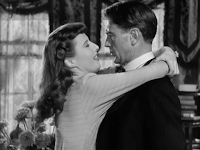 Another film with Barbara Stanwyck as a gangster's moll and Gary Cooper as an innocent professor in Ball of Fire, directed by Howard Hawks.
 Another with Robert Montgomery, Mr. and Mrs. Smith, co-starring Carole Lombard, about a couple who find they are technically not really married. Alfred Hitchcock's only comedy and pretty funny.
Three from 1942. To Be or Not to Be, starring
 Carole Lombard again and Jack Benny as Polish actors outsmarting Nazis, directed by Ernst Lubitsch. (Remade in 1983 by Mel Brooks.)
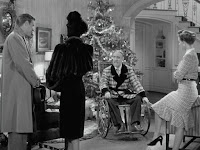 The Man Who Came to Dinner, directed by William Keighly, starring Bette Davis and Monte Woolley as the most insufferable guest of all time, with Ann Sheridan.
 Larceny, Inc. -- Edward G. Robinson as a crook who succeeds in business without really trying. Directed by Lloyd Bacon.
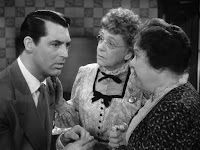
From 1944, Arsenic and Old Lace, starring Cary Grant who discovers his aunts are bonkers. With Priscilla Lane, Raymond Massey and Peter Lorre.
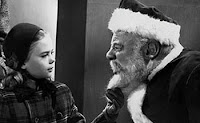 Miracle on 34th Street from 1947. Little Natalie Wood doesn't believe in Santa Claus. With Maureen O'Hara, John Payne, and Edmund Gwenn.
 Abbott and Costello Meet Frankenstein from 1948. The title tells you everything.
 Number 15, from 1949, is Adam's Rib, written by Garson Kanin and Ruth Gordon, starring Katherine Hepburn and Spencer Tracy as lawyers facing each other at a trial. Directed by George Cukor. Not exactly one of my favorites, but iconic.
Go have some laughs.
*****
Three major film stars are at their most comfortably likeable in Mr. Blandings Builds His Dream House from 1948. Directed by H.C. Potter, it features Cary Grant, Myrna Loy and Melvyn Douglas. Most people who know this film have an affection for it because it is so easy to relate to the trauma of buying a house: the expense that always exceeds the expectations, the disruption, the delays, the inconvenience, the unexpected problems, and the way that it crowds out everything else in your life.
This is illustrated so charmingly by the cast of players that the simplest things like a door that sticks and then comes unstuck by itself, having no clue of what the carpenter is talking about but being unwilling to acknowledge it, a husband and wife trying to use the only bathroom at the same time are so humanly funny that we relate to it all. My particular favorite, as someone who has dealt with a patronizing contractor or two in my time, is when Myrna Loy goes into extreme detail to describe her color scheme only to have it reduced to "red, green, blue, yellow, white" when the little woman is gone.
This film is also further evidence of how easy Cary Grant made it look. When you consider him as Walter Burns in His Girl Friday and watch him as Jim Blandings, the advertising exec and harried family man, you get a better appreciation of his art, and how he is always Cary Grant, but not the same Cary Grant.
 And the other fifteen? From 1940, The Bank Dick, is a short and hilarious romp starring W.C. Fields.
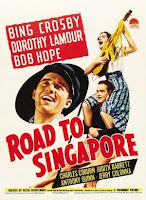 The Road to Singapore, also from 1940, is the first Bing Crosby and Bob Hope road picture. With Dorothy Lamour.
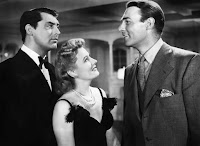 One more from 1940, My Favorite Wife, starring Cary Grant and Irene Dunne. She comes back after 7 years, he's just remarried to Gail Patrick. Remade a bunch of times.
 Travels. Preston Sturges writes and directs Joel McCrea as a movie director who tries to live among the poor as 'research'. With Veronica Lake. Second, the other Preston Sturges film is The Lady Eve, starring Barbara Stanwyck trying to outsmart Henry Fonda. With Sturges
 regular, William Demarest.
*****
 And the other fifteen? From 1940, The Bank Dick, is a short and hilarious romp starring W.C. Fields.
 The Road to Singapore, also from 1940, is the first Bing Crosby and Bob Hope road picture. With Dorothy Lamour.
 One more from 1940, My Favorite Wife, starring Cary Grant and Irene Dunne. She comes back after 7 years, he's just remarried to Gail Patrick. Remade a bunch of times.
Five comedies from 1941. First, Sullivan's


 Another film with Barbara Stanwyck as a gangster's moll and Gary Cooper as an innocent professor in Ball of Fire, directed by Howard Hawks.
Here Comes Mr. Jordan stars Robert Montgomery who dies too soon so 'officials' give him another body. Directed by Alexander Hall.


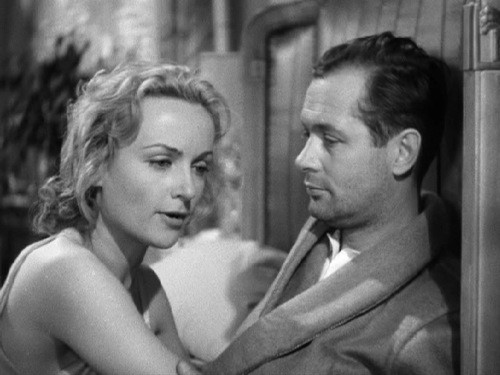
Three from 1942. To Be or Not to Be, starring

 The Man Who Came to Dinner, directed by William Keighly, starring Bette Davis and Monte Woolley as the most insufferable guest of all time, with Ann Sheridan.
 Larceny, Inc. -- Edward G. Robinson as a crook who succeeds in business without really trying. Directed by Lloyd Bacon.
From 1944, Arsenic and Old Lace, starring Cary Grant who discovers his aunts are bonkers. With Priscilla Lane, Raymond Massey and Peter Lorre.
 Miracle on 34th Street from 1947. Little Natalie Wood doesn't believe in Santa Claus. With Maureen O'Hara, John Payne, and Edmund Gwenn.
 Number 15, from 1949, is Adam's Rib, written by Garson Kanin and Ruth Gordon, starring Katherine Hepburn and Spencer Tracy as lawyers facing each other at a trial. Directed by George Cukor. Not exactly one of my favorites, but iconic.
 Go have some laughs.